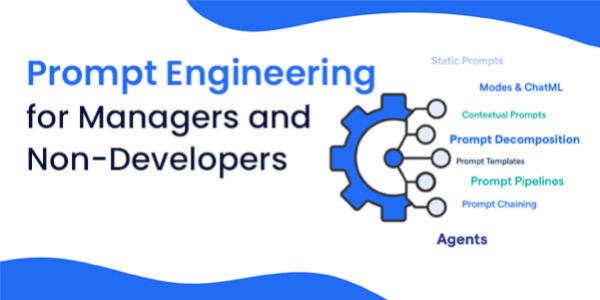
Prompt Engineering for Managers and Non-Developers
Master prompt engineering to effectively communicate with AI tools, boost productivity, and optimize business outcomes, no coding or technical background needed.
Duration: 1 Day
Hours: 2 Hours
Training Level: All Levels
Batch Three
Thursday, March 19, 2026
12:00 PM - 02:00 PM (Eastern Time)
Batch Four
Tuesday, April 21, 2026
12:00 PM - 02:00 PM (Eastern Time)
Batch Five
Friday, May 29, 2026
12:00 PM - 02:00 PM (Eastern Time)
Batch Six
Thursday, June 18, 2026
12:00 PM - 02:00 PM (Eastern Time)
About the Course:
AI tools like ChatGPT and other large language models are quickly becoming core productivity accelerators for product, project, design, and engineering teams. But most professionals lack the skills to communicate with these models effectively.
This workshop teaches managers how to think, structure, and iterate prompts to improve clarity, reduce rework, and generate reliable outputs. Participants will learn practical prompt patterns, apply them to real work scenarios, and walk away able to guide their teams on safe, effective AI usage.
Course Objective
By the end of this course, participants will be able to:
- Understand how large language models interpret instructions and context.
- Write clear, structured prompts using role, task, format, and constraints.
- Apply prompt patterns for analysis, planning, synthesis, research, and writing.
- Iterate prompts using feedback loops and evaluation criteria.
- Detect hallucinations and improve accuracy with grounding techniques.
- Use prompting for project briefs, meeting summaries, requirements, and stakeholder communication.
- Coach teams on responsible AI usage, privacy protections, and review practices.
- Build reusable prompt libraries for consistent team outputs.
Who is the Target Audience?
- People Managers and Team Leads.
- Product Managers and Project Managers.
- Scrum Masters, TPMs, and Business Analysts.
- Change managers, operations managers, and consultants.
Basic Knowledge:
- Ideal for anyone using AI to improve clarity, speed, and decision-making.
Curriculum
Total Duration: 2 Hours
Kickoff & Mental Models
- What LLMs are (and are not)
- Why bad prompts fail
- Task vs. context vs. constraints
Prompt Structure Fundamentals
- Role assignment (“Act as…”)
- Clear task statements
- Output formatting (tables, lists, JSON, outlines)
- Constraints and success criteria
Prompt Patterns for Managers
- Summarization (structured vs. abstract)
- Comparison and decision matrices
- Action plan generation
- Meeting note extraction
- Risk identification
- Dependency mapping
Iteration & Refinement Loops
- “Critique your own answer,” prompting
- Chain-of-feedback patterns
- Prompt decomposition (breaking complex tasks down)
Grounding & Accuracy Techniques
- Provide context documents
- Ask for citations and sources
- Use stepwise reasoning
- Reality checks and verification prompts
Reducing Bias & Hallucination
- Stating unknowns explicitly
- Asking for confidence scores
- Scenario testing
- Multiple-perspective interrogation
Prompting for Communication
- Tone shifting for executives vs. peers
- Message distillation
- Email drafting and rewrite patterns
- Explainer prompts for technical topics
Prompting for Planning
- Work breakdown structures
- Project milestone drafting
- Risk registers and mitigation actions
- Dependency assumptions
Prompting for Analysis
- Trade-off matrices
- SWOT and alternatives analysis
- Root-cause probing
- Theme clustering from text data
Creating Prompt Libraries
- Reusable templates (summaries, retros, specs)
- Department-level prompt packs
- Versioning and team sharing
AI Governance & Safety Basics
- Privacy and confidentiality considerations
- Review loops with human oversight
- When NOT to use AI
- Avoiding over-reliance
Coaching Teams on Prompting
- Common mistakes to watch for
- Prompt hygiene practices
- Review/feedback frameworks
Anti-Patterns
- Over-prompting
- Blind trust
- Output copy/paste culture
- Scope creep inside a single prompt